
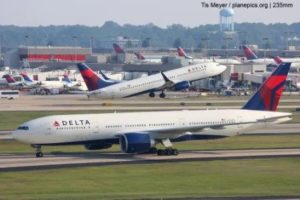
 Mikel had a very slight build, I guessed 25-ish, with an engaging smile and an earnestness about him that I found difficult to ignore. While I usually quickly say “No, thank you…” to the credit card promoters in the airport terminal, or just try and avoid making eye contact, Mikel was serious about wanting to engage people. After I spoke with him a bit, his earnestness might also be able to be seen as unusual drive to make his day happen. I sensed that he had come from a state of very deep poverty, and I was correct as I learned more about him. He asked what I did, and when I said that I was in my own business as a consultant, he right away asked how I might help him be more successful in his own quest to be a global consultant, that he was trying to get started. I tried to share that my own network of contacts that made up my initial business came from 35+ years of work in a somewhat specialized field, and that you can’t create that experience any other way than by a lot of years doing something, but that he should believe in his own success as very possible if he keeps engaging people the way he did me.
Staying positive…
After we talked about his goals and ambitions, he asked me how I stayed so positive and optimistic while starting a new business. I explained that much of it for me comes from having faced threats to my life and survived, and that those experiences make me value the people and relationships I’m allowed to enjoy and develop, even some as short as the one I shared with him, that his perseverance was infectious. He then shared that he had grown up in a war-torn place in eastern Africa, and I expect that one of the reasons he was so small was due to really poor nutrition for many of his early years. He had seen horrible things happen around him, had lost the sight in one eye, and he felt really lucky to be able to pursue his dreams in America, that many people he knew when he was young would never have the opportunities he now had.
Thank you, Mikel, for lifting me up that day.
I decided to let Delta know how much I appreciated their young credit card fellow.
————— Original Message —————
To: wecare@delta.com
Subject: OCSD-Share a Compliment-General Feedback-Other General Feedback
I met a wonderful young man today, and I just wanted to share my experience. I don’t know if he is a full-fledged Delta employee or a contractor, but he connects very well with people and deserves to be recognized as a sincere and positive contributor in the airport there in Atlanta. He was in the B terminal I believe between B24 and B32 perhaps, promoting the Delta credit cards today. His name is Mikell (not sure of spelling), and while I usually brush these folks off after years of frequent travel, he seemed really sincere and pleasant, so I talked with him a bit. He really did want to know a little more about me, and in just a few minutes, I really felt lifted up by just having had the chance to meet him. He is a really decent guy, and I thank him for being there today. Nice job, Mikell. The world can be a thankless place sometimes, but you are making a difference just by showing interest in people you meet.
—————————————————-
Hello David,
RE: Case 02059332
Thank you for writing us regarding your experience with Mikel, one of our American Express vendors in the Atlanta airport. While our American Express vendor team work hard every day, I was very pleased that Mikel left such an impression on you. This is the impact we want our employees to make on our passengers.
We are glad that your experience exceeded your expectations. I have forwarded your kind words to our Airport Customer Service Leadership team so they can commend Mikel for his exemplary customer service and also use him as an example for others to follow.
David, thank you for being the best part of Delta and a valued SkyMiles member! I hope that you have a wonderful weekend and we look forward to seeing you on another Delta flight soon!
Regards,
Curtis C. Speziale Jr
Customer Care

 I think from time to time that we all need to ponder whether our life is or was planned, our experiences through childhood considered by our parents, what God’s plan is for us, and how much we’ve taken the best advantage of the gifts of all kinds that we’ve been granted. We are all left to wonder whether our circumstances and experiences were random? Fate or destiny? Planned?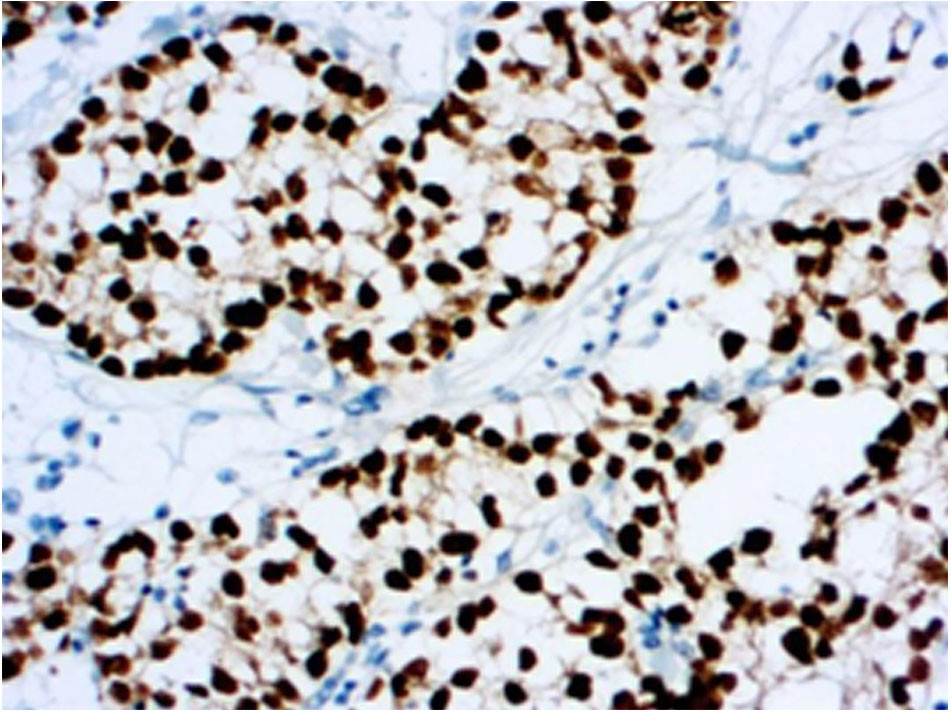
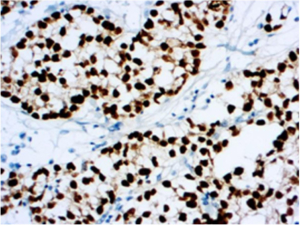 I graduated from college early and went home to farm. A year and half later, I found a lump on my right testicle. It kept getting larger and I saw a urologist, who assured me it was epididymitis, certainly not cancerous. What I needed to do was soak in a hot bath for an hour a day, and take heavy duty antibiotics. We had one bathroom at the farm, and dedicating an hour a day to one person was another lesson in sharing. I come from a family of 16 children. So I did my soaking and medicating, and the lump continued to grow. I decided to seek another opinion after a couple months. I found another urologist in Green Bay and in less than a minute of palpating my lump said flatly, “you have testicular cancer and that needs to come out. Can you be back here at 7 am for surgery?” I was pretty much in shock, especially after having the other urologist reassure me that there was no way it could be cancer. I needed a little time. And for me, a third opinion. My 16-year old sister had just finished 6 months of chemo for Hodgkin’s lymphoma, and she also had had a negative local medical experience and had moved her medical work 6 hours away to Mayo. I called for an appointment and her doctor shepherded me through to a great team, who did blood work and an ultrasound and still couldn’t be sure of what I had until they did the surgery. They did the pathology while I was in surgery, and I ended up having a radical orchiectomy and the cancer was Stage 3 seminoma. A “good type” to have. A good type? Really? I was 23 and dating a wonderful woman, but I didn’t know what was going to happen to me. They sent me home to the farm with orders to start radiation to the pelvis and abdominal spine in a month. The cancer had metastasized into a number of lymph nodes along my spine, and they thought the radiation would keep it from progressing any further. My girlfriend never showed that she doubted that I would survive this, and was my source of strength and faith throughout. I truly believe that she carried me spiritually the whole time. I had started working off the farm, and I was able to work things out with my boss to leave work at 1:30 every day and drive 90 minutes each way to Milwaukee, 5 days a week, from mid-May to mid-September. It was the worst four months of my life. Nausea, terrible constant diarrhea, and the worst repeated skin burning I would ever experience. I had to change burn bandages daily front and back. They warned me beforehand that I might never have children, and that I should consider setting up a sperm bank. My girlfriend and I weren’t to the point of talking about our life plans in those terms yet, but she had a 6 year old son, and I figured that would be enough family for me if that was the way things turned out. Never mind that I didn’t have the money for a sperm bank. Three months after the radiation was done, I asked her to marry me.
 A very good friend of mine took his own life last Wednesday. He had struggled with depression for several years, but I’m sure that the isolation of COVID-19 contributed. How could it not? He had been a multi-site department manager in healthcare, but had lost his job a few years ago, and never was able to shake that loss or shame, never found that “what next?” moment in his life after that. I tried to get together with him a number of times, but now I feel as though it was not nearly enough times for me to feel OK. I tried, but not enough. How I wish I had made even one more effort to reach out to him, have a beer, a coffee, anything. He was tremendously talented and a smart guy in areas that I know nothing of. He always seemed to gregariously attract helpers for any home project or tree cutting adventure, and was quick to lend a hand in return. I don’t think any of us realized, or at least were willing to admit, that he was churning inside so deeply.
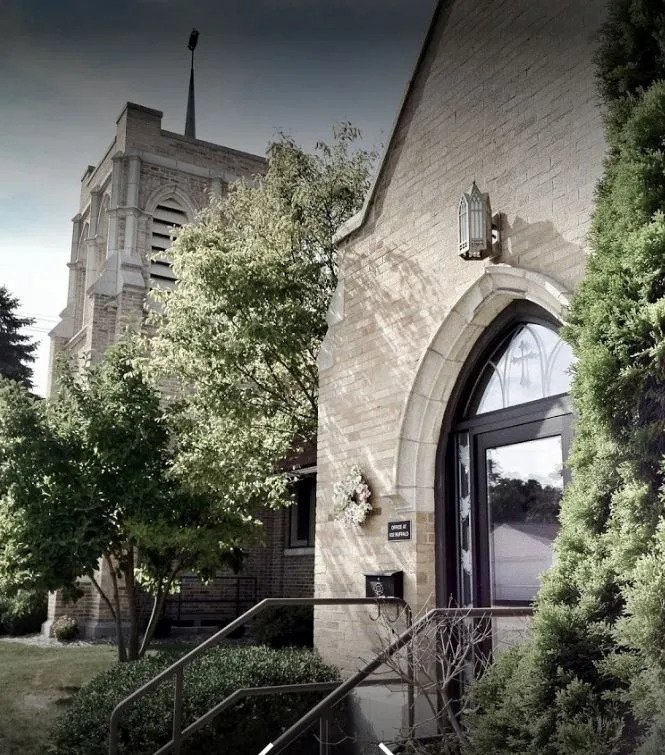
 Our little St. Peter’s Church had beautiful stained glass windows. It had a small organ, small choir, but we made good music. Our pastor always believed that we could do big things, even if our congregation was small. Even though it was a task that should be performed by a deacon, he taught me how to sing (chant) the Great Litany during Lent, and it remains one of my favorite service elements of the church year. The significance of The Great Litany is deep: It is the oldest original English language rite, dating to 5th century Romans, it is all-encompassing and focuses prayers for ourselves and for the world, and it is the strongest way to begin “keeping a Holy Lent.”
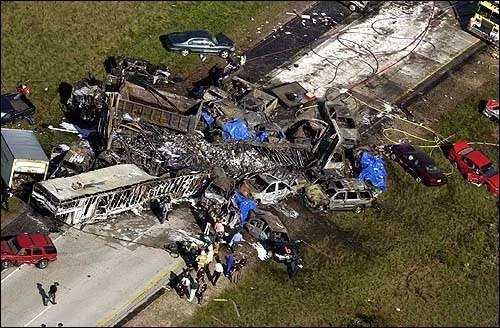
 October 11, 2002. Early that morning, my wife and I packed up our things and we were headed for Milwaukee. We left before breakfast, thinking that we would eat once we got further down the road. We were going to babysit our grandkids while our son and daughter-in-law flew out on a short trip. We were on a tight schedule, coordinated so that they could leave for the airport in plenty of time. Just before we got on the interstate, I insisted that I just needed a quick donut from the convenience store, even though she didn’t want me to delay us. As we got on the interstate, there was more low fog, as I-43 runs along Lake Michigan’s coastline pretty tight in some areas. A few miles south of Sheboygan, the fog really started getting heavy, we slowed down a lot, and I had to hit my brakes hard as I saw a vehicle in front of me pull over hard and the driver jumped out – turned out he was a local volunteer fireman that had been directed to divert traffic off the interstate. He frantically waved us to get off the highway at the exit ramp. I rolled down the window to ask what was up and he just screamed “Get off the highway! There’s a huge pileup just ahead! Get off now!” We took a meandering parallel way on back roads south and got back on I-43 a few miles later. One of the kids called us, as they knew our morning schedule, and they wanted to know if we had seen the big pile-up. We had not. They said it was all over the news, that there was a big pileup in the fog near Oostburg. People who experienced it said it was suddenly a “wall of fog”, and we can attest to that. In the end, there were ~40 vehicles involved, 10 deaths, and 39 injured in the deadliest traffic incident in Wisconsin’s history. The first responder who waved us off the highway turned out to be our lifesaver that day, but the donut played a part, too. Had I not stopped for the donut, we would have been at that spot 2-3 minutes sooner, and never have seen the first responder.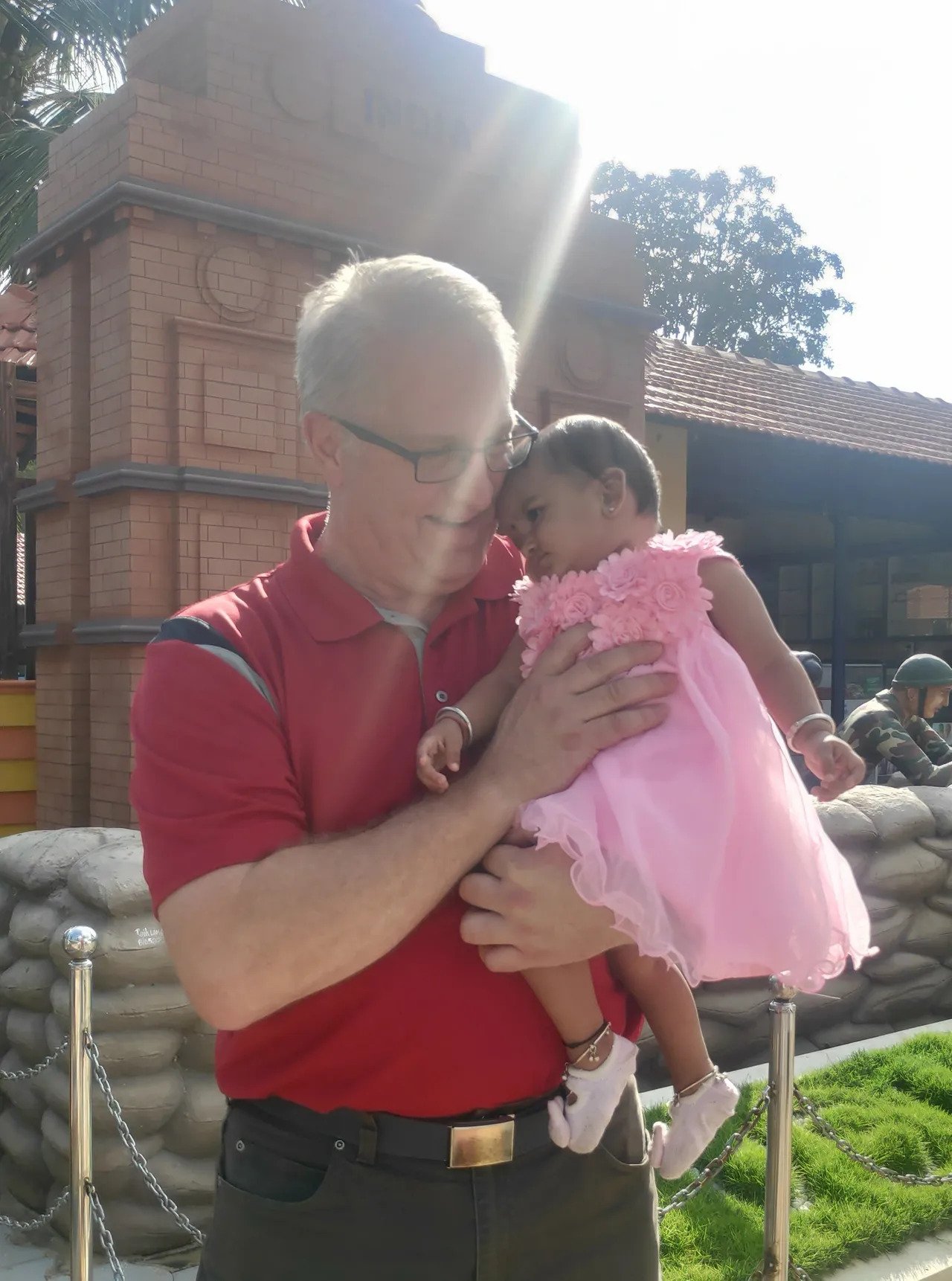
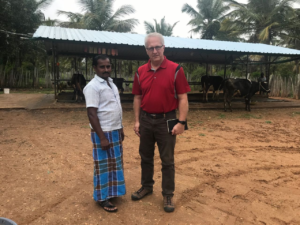
 I had the wonderful opportunity to visit India in 2019. My first stop was in Tiptur, Karnataka, about 3 hours’ drive west of Bengaluru. They speak a language called Kannada there. Hoṭṭe tumbide (sounds like “otay toombiday”) is a Kannada phrase that means “Full stomach”. When I learned the phrase, I had just finished a very filling lunch meal with 5-6 Karnatakan fellows, and while I indeed had a full stomach from the fantastic lunch presentation and meal, they helped me understand that hoṭṭe tumbide had a second meaning or connotation, that one’s life was full, a feeling encompassing gratefulness and peaceful satisfaction, one which transcended the fullness from the meal itself. I found myself feeling that hoṭṭe tumbide feeling, along with a desire to help others experience that feeling. It lent itself well to using it as a general greeting. The locals certainly found it engaging and positive.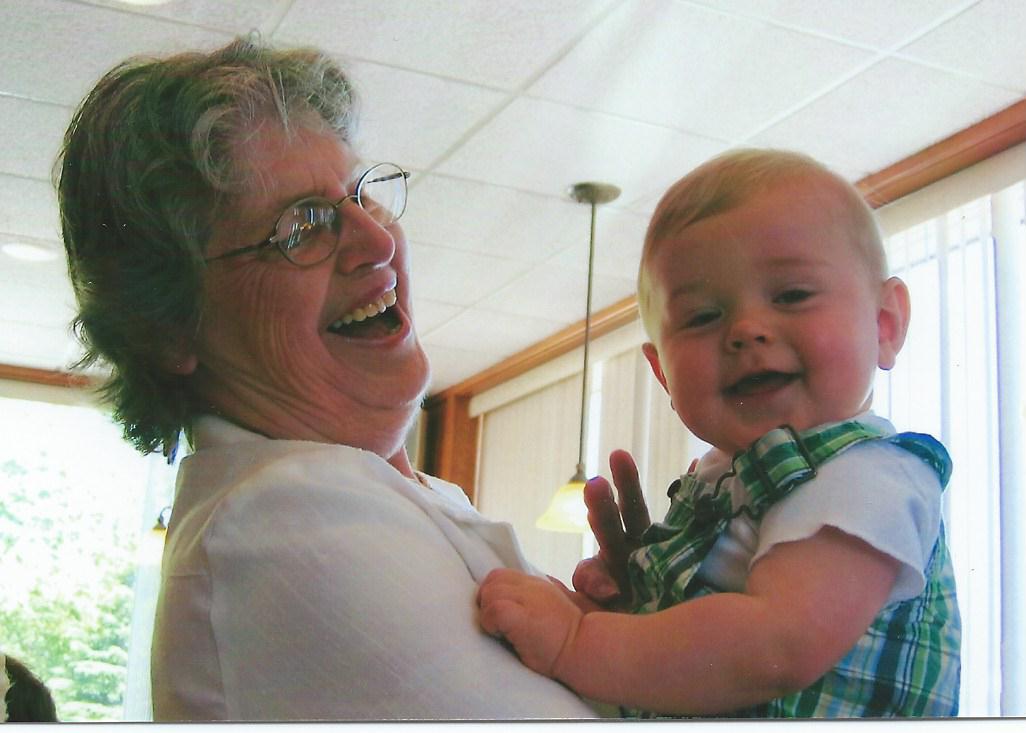
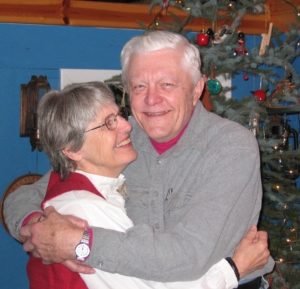
 My dad did, too, but that’s another story. My mother was what you would call an extremely hard-working, high-achieving champion of her beliefs and her family. I am the 3rd son born to my parents, and after I was born, my parents started adopting. They didn’t stop until they had adopted 13 more – 5 from Korea, 3 from the Philippines, and 5 mixed-race from the U.S. All considered “hard-to-place” kids. Both of my parents were highly involved in the equal rights movement of the ‘60’s in Milwaukee, taking us to picket for our first time when I was only 5 years old, protesting the prohibition of black membership in social clubs like the Elks. She took us all along as kids while she taught English to migrant worker families (some of whom ended up lifelong friends), but most of all, our parents taught us to appreciate other cultures, foods, music, people who didn’t look like us or talk like us. It shaped us all, and I didn’t really appreciate that for many years. She also taught us to live thankfully, with gratefulness simmered into our sauce, and with a song on our hearts and a smile on our face.